
What Is a Quant? Definition, Five Roles & a Worked Example
Understand the meaning of quant, compare five quant careers, verify a small research example with returns and costs, and choose a practical four-week starting plan.
On this page
A quant is a finance professional who uses mathematics, statistics and computer programs to value investments, measure risk or make trading decisions. The name is commonly short for quantitative analyst, but it also covers researchers, traders and developers. What connects these jobs is a model that can be tested and explained; what separates them is the decision and deliverable each person owns.
What to know first
- Quant is an informal finance term, with other dictionary meanings. In a finance conversation, it usually refers to a person doing quantitative work.
- A researcher tests an idea; a trader manages decisions and execution; a developer builds dependable software; pricing and risk specialists answer different financial questions.
- Returns, transaction costs, data timing and the possibility of being wrong belong in the same analysis. A profitable toy example does not establish a trading advantage.
- Degree requirements belong to individual job descriptions. Official examples include bachelor’s/master’s research entry points and separate PhD research positions.
- Start by completing and explaining one small calculation. QuantSteps has an available QR course route; its QT and QD specialist routes are currently blueprints.
Quant definition: what does the word mean?
A quant is a finance professional who uses mathematics, statistics and computer programs to value investments, measure risk or make trading decisions. A model might estimate an option’s value, compare investment signals or show how a portfolio behaves when prices fall.
Quant is commonly shorthand for quantitative analyst. The plural is quants. Oxford identifies it as an informal finance noun; its pronunciation is /kwɑːnt/ in US English and /kwɒnt/ in UK English. Oxford dictionary entry.
Context matters. Collins also records a separate British meaning for a pole used to move a boat, and Quant as a surname, including the designer Mary Quant. These meanings are unrelated to a finance career. This guide uses the financial meaning throughout. Collins dictionary entry.
A quant is a person; quantitative finance is the field; quantitative trading is an activity. The field includes valuation and risk modelling that may never produce a trade. Quantitative trading uses numerical models and testable rules to decide what to trade, how much to hold and which risks to accept. See what quant trading means for its strategy, execution and cost questions. Quantitative analysis is the process of using numerical evidence, including outside finance.
The US occupational profile includes investment analysis, valuation, portfolio tools and risk models. A quant’s job therefore reaches beyond predicting the next stock price. O*NET: Financial Quantitative Analysts.
Five quant roles: the question and the deliverable
Job titles overlap. A “quantitative analyst” might work on investment research, derivatives pricing, execution or credit risk. Read the responsibilities before treating the title as a fixed category. These five useful groupings describe work rather than a universal hierarchy.
| Role | Main question | Typical deliverable | Skills that matter for this work |
|---|---|---|---|
| Quantitative researcher, QR | Does this idea survive a fair test? | Reproducible study, signal or portfolio model | Statistics, experimental design, programming, financial data |
| Quantitative trader, QT | What should we trade, at what price and with what exposure? | Trading decisions, execution rules, position and profit-and-loss (P&L) analysis | Probability, decision making, market mechanics, risk |
| Quantitative developer, QD | Can the team run the calculation correctly and dependably? | Data pipeline, research platform, pricing or trading software | Software design, algorithms, testing, performance |
| Pricing or desk quantitative analyst | How should this instrument be valued and hedged? | Pricing model, calibration and sensitivity tools | Mathematical finance, numerical methods, product knowledge |
| Risk quant or model validator | Where can the portfolio or model fail? | Stress analysis, risk estimates or independent validation findings | Statistical modelling, scenario analysis, documentation |
In the pricing row, calibration means fitting model parameters to observed market quotes. Sensitivities describe how an estimated value changes when an input changes. Hedging means taking a position intended to reduce a particular exposure; it need not eliminate every risk.
For a fuller view of how these outputs connect during a working day, read what a quant does. This guide concentrates on the definition and the differences between roles.
Quantitative researcher
A researcher defines a testable question, inspects the data, establishes a comparator and evaluates results on observations excluded from model fitting. Jane Street describes research spanning datasets, models, strategies and their implementation. That combination makes a readable research argument as important as a fitted model. Jane Street quantitative research.
Example task: investigate whether yesterday’s unusually high volume helps forecast tomorrow’s return. Save the information available at each decision time, compare against a simple baseline (a reference calculation), include costs and document failed variants. The deliverable could be a report recommending no deployment because the apparent effect disappears in the held-out period (data excluded from model fitting). That is a useful research outcome.
Quantitative trader
A trader connects models to positions, orders and risk decisions. Jane Street’s trading description includes investigating pricing differences, developing models, managing risk and exploring products. It also says prior finance knowledge and a specific programming language are not prerequisites for that role. This is one employer example, not a rule for every trader. Jane Street quantitative trader.
Example task: a model suggests buying, but an order may pay more than the expected benefit once the spread and fees are included. Estimate that trade-off, set a position limit and decide whether to quote, wait or reduce exposure. The deliverable includes a reason for the decision and an explanation of subsequent P&L, rather than just a buy signal.
Quantitative developer
A developer turns calculations and data into software other people can rely on. The role can concentrate on research tools, trading systems or pricing libraries; it does not always mean low-latency C++. Jane Street’s engineering page, for example, describes OCaml and Python and prioritises engineering ability over prior knowledge of its languages or finance. Its title is software engineer, illustrating why adjacent titles also matter. Jane Street software engineer.
Example task: implement the return calculation below with checks for invalid prices, duplicate timestamps and missing observations. Prove the order simulator agrees with a hand calculation and that a rerun produces the same report. A dependable implementation is the deliverable even if the trading idea fails.
Pricing or desk quantitative analyst
A pricing specialist models an instrument’s cash flows and uncertainty and supplies values and sensitivities to desk users. Citi’s commodities example explicitly combines pricing libraries, risk analytics, numerical techniques and production software. Citi commodities quantitative analyst.
Example task: value an option, calibrate its model to observed market quotes and compare sensitivity estimates when the underlying price or volatility changes. The deliverable is a tested valuation and hedging tool with documented assumptions. Historical returns alone do not determine an option’s fair value.
Risk quant or model validator
Risk modelling and independent model validation are related but distinct responsibilities. A risk modeller estimates exposures and losses. A validator challenges model assumptions, implementation and limitations. Citi’s second-line validation example includes independent challenge, reviews, technical reports and communicating findings. Citi model validation example.
Example task: test a portfolio under a large price decline and wider trading costs, then investigate whether the reported risk misses concentrated exposures. A validator might reproduce the calculation independently and require a limitation to be corrected. The output helps someone decide whether the model can be used and under what constraints.
A small quant example you can check by hand
Consider four invented prices: $100, $102, $101, $103. There are three price intervals. Start with $110 cash, no leverage, no interest or dividends, and a fixed $0.10 cost per order. Assume each order fills at the listed price. This deliberately simple cost is an assumption, not a typical broker fee.
Before observing the path, specify this toy schedule: buy one share at the first price, sell at the second, buy one share at the third and sell at the fourth. Hold cash between the second and third prices. It is an arithmetic illustration, not an economically justified prediction rule.
The asset’s simple interval returns are 2.0000%, −0.9804% and 1.9802%, calculated as new price / old price − 1. Its compounded price return is 103 / 100 − 1 = 3%. Adding the three interval percentages gives a different answer because returns compound.
Follow the cash and the share
| Event | Cash after the order | Shares after the order | Portfolio value at that price |
|---|---|---|---|
| Before any trade | $110.00 | 0 | $110.00 |
| Buy at $100; pay $0.10 | $9.90 | 1 | $109.90 |
| Sell at $102; pay $0.10 | $111.80 | 0 | $111.80 |
| Buy at $101; pay $0.10 | $10.70 | 1 | $111.70 |
| Sell at $103; pay $0.10 | $113.60 | 0 | $113.60 |
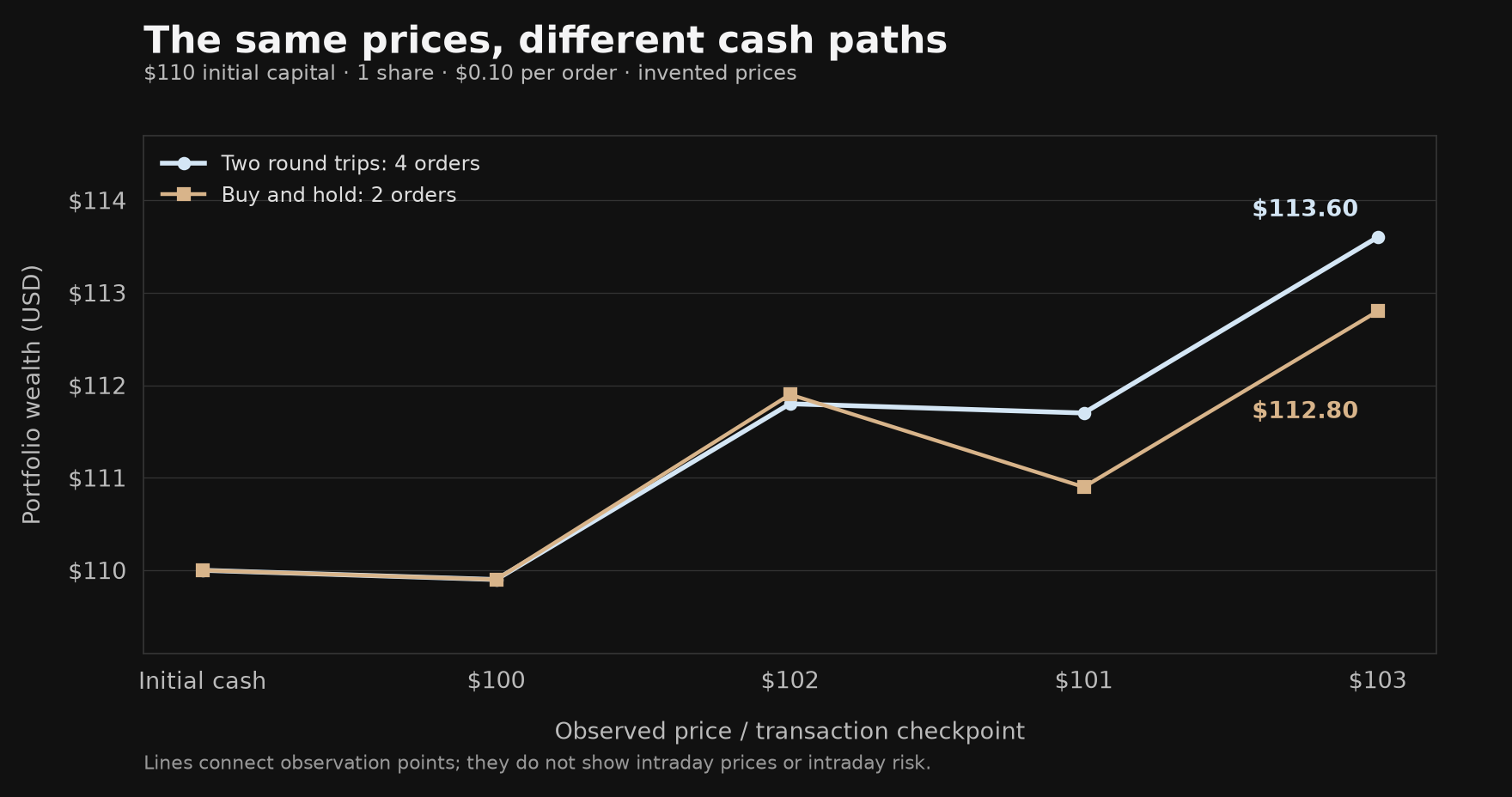
Lines connect transaction checkpoints; intraday price movements are not observed.
Gross trading profit is (102 − 100) + (103 − 101) = $4. Four orders cost $0.40, so net profit is $3.60 and net return on the initial $110 is 3.2727%. The denominator includes the cash kept aside.
The comparator buys one share at $100 and sells at $103. Its gross profit is $3; two orders cost $0.20. Its final wealth is $112.80, a 2.5455% net portfolio return. Both approaches use the same initial capital and one-share position size.
Inspect risk and challenge the cost assumption
Maximum drawdown is the largest decline from an earlier peak in a specified wealth series. Using the five portfolio values above, the schedule’s largest observed drawdown is 0.10 / 110 = 0.0909%, caused by the first order’s cost. The comparator’s values are 110, 109.90, 111.90, 110.90, 112.80; its largest observed drawdown is 1 / 111.90 = 0.8937%. These are drawdowns at our observation points; unseen intraday losses are unknown.
Change only the cost per order. The schedule’s net profit is 4 − 4c; the comparator’s is 3 − 2c.
| Cost c per order | Schedule net profit | Comparator net profit | Which has the higher return on $110? |
|---|---|---|---|
| $0.00 | $4.00 | $3.00 | Schedule |
| $0.10 | $3.60 | $2.80 | Schedule |
| $0.50 | $2.00 | $2.00 | Equal |
| $1.00 | $0.00 | $1.00 | Comparator |
The apparent benefit disappears at $0.50 per order. More trading can consume an otherwise favourable result. A realistic test would also specify bid–ask spreads, fill timing, price impact, position limits and whether every input was actually available when the decision was made.
Reproduce the arithmetic
def max_drawdown(values):
    peak = values[0]
    worst = 0.0
    for value in values:
        peak = max(peak, value)
        worst = max(worst, 1 - value / peak)
    return worst

capital, cost = 110.0, 0.10
schedule = [capital, capital - cost,
            capital + 2 - 2 * cost,
            capital + 2 - 3 * cost,
            capital + 4 - 4 * cost]
hold = [capital, capital - cost,
        capital + 2 - cost,
        capital + 1 - cost,
        capital + 3 - 2 * cost]
for name, wealth in [("schedule", schedule), ("hold", hold)]:
    print(name, round(wealth[-1], 2),
          round(100 * (wealth[-1] / capital - 1), 4),
          round(100 * max_drawdown(wealth), 4))
Expected output is schedule 113.6 3.2727 0.0909 and hold 112.8 2.5455 0.8937, with return and drawdown expressed in percent.
A researcher would question the rule and evaluate unseen data; a trader would question fill and risk assumptions; a developer would verify the cash accounting; a risk specialist would try adverse scenarios. A pricing specialist would need a defined financial contract and additional modelling assumptions. Four invented prices establish none of those professional conclusions.
Buy-side, sell-side and proprietary trading work
Buy-side investment teams allocate investor capital. For a systematic fund or asset manager, a research question might ask whether a signal improves a portfolio after costs and risk constraints. Citadel describes investment research feeding models and trading approaches; PGIM’s explanation adds an important point: economic reasoning and human portfolio judgement can remain part of quantitative investing. Citadel graduate research, PGIM: What is a quant?.
Sell-side businesses provide investment products and services. A bank quant may build a pricing tool or an algorithm used to execute a client’s orders. That is quantitative work even when its goal is execution quality rather than a proprietary prediction strategy. Citi’s equities example combines execution algorithms, market-impact models, analysis and implementation. Citi equities algorithmic trading.
Proprietary trading and market making add another context: the firm trades its own capital and may supply liquidity. Researchers, traders and engineers can collaborate closely, with boundaries differing by team.
Treat these labels as orientation, not promises about autonomy, hours, salary or security. Integrated firms can contain several business models. CFA Institute explicitly cautions that the buy-side/sell-side split does not fit every firm cleanly. Ask whose capital is at risk, who uses the output and how success is assessed. CFA Institute career overview.
What maths, programming and finance does a quant need?
Learn the foundation, then specialise around a task. An admissions prerequisite list is useful orientation: Carnegie Mellon’s computational finance master’s lists calculus, linear algebra, calculus-based probability and programming. It is a programme’s entry requirement, not a universal job checklist. CMU MSCF admissions.
| Foundation | A concrete ability to demonstrate | Where to extend it |
|---|---|---|
| Probability and statistics | Explain an expectation, uncertainty and why a small sample can mislead | Time series and research design for QR; decisions and risk for QT |
| Linear algebra and optimisation | Work with vectors, correlations and a constrained objective | Portfolio construction, factor models, calibration |
| Programming and data | Validate inputs, reproduce calculations and test edge cases | Scientific Python for research; reliable systems for QD |
| Market knowledge | Explain prices, returns, positions, costs and information timing | The instruments and execution setting of a specific desk |
| Communication | State a claim, assumptions, evidence and a reason to reject it | Research reports, model documents and collaborative decisions |
Stochastic calculus and numerical methods matter particularly for certain derivatives models. They need not be your first topic when you are learning basic return analysis. Similarly, deep learning is a tool to justify against a baseline, not an automatic upgrade.
Python is a useful learning choice, but one language does not define the profession. Read the team’s requirements and distinguish prototyping from maintaining production software.
Do you need a PhD? Check the actual role
There is no single degree requirement for every quant job. These official examples were checked on 3 October 2026. They illustrate different requirements and should not be treated as a list of guaranteed available vacancies.
| Official role example | Education statement on the page | What it means for your decision |
|---|---|---|
| Citadel research analyst, university graduate, US | Bachelor’s or master’s in a highly quantitative field | Some research entry points do not require a PhD; research and coding evidence still matter |
| Citadel researcher, PhD graduate, US | PhD in a highly quantitative field | A separate research route explicitly requires doctoral training |
| Citi commodities quantitative analyst, VP | Master’s or PhD in a quantitative discipline | This pricing role also expects relevant modelling and production-code experience |
| Citi model validation lead, VP | Bachelor’s; master’s preferred | The page also lists substantial experience; this is not a graduate shortcut |
The trading and engineering descriptions linked above focus on quantitative or programming ability and do not state a particular degree requirement. An omitted requirement is not evidence that every applicant without a degree will be accepted.
Before choosing a degree, compare several target descriptions. Separate required from preferred, record experience and location constraints, and identify the work you cannot yet demonstrate. A master’s can supply foundations and recruiting access; a PhD can develop research depth. Neither replaces the role’s practical expectations.
What does a quant earn?
Compensation depends on role, geography, level and employer. “Quant salary” can mix a bank risk position with a trading-firm researcher, or mix base salary with a performance-dependent bonus.
Use the US quantitative analyst salary guide to compare disclosed examples and compensation components. The dedicated researcher salary guide distinguishes graduate and experienced research roles. For engineering, the quant developer salary guide compares the relevant specialties. Keep the role, location and observation date attached to any number. A posted base-pay range is not a guaranteed offer, and a discretionary bonus is not guaranteed income.
How to decide whether quant work fits you
Try the task before choosing the title. Reproduce the example above and explain it without reading the answer. Then change one assumption: remove an observation, raise costs or use a different price path. Write what your earlier conclusion depended on.
Notice which part holds your attention. If you enjoy asking whether the evidence survives another test, explore research. If you enjoy making a decision under changing prices and constraints, investigate trading. If you enjoy catching numerical or software failures, explore development. If contracts and sensitivities interest you, examine pricing. If you enjoy finding weaknesses and explaining their consequences, examine risk and validation.
Useful signs are patience with messy inputs, comfort saying “this result is inconclusive,” and willingness to show someone how you reached an answer. Difficulty with a first exercise identifies a learning need, not a verdict on your future. Wanting a high salary alone provides little information about whether you will enjoy repeated modelling, coding and review.
A four-week introduction with a concrete output
Budget four to six hours per week as a suggested starting pace. Extend the plan if the calculations or code are new. Its goal is one understandable piece of work and a better role choice; it is not a promise of interview readiness in a month.
| Week | Work to do | Evidence to save |
|---|---|---|
| 1: calculate and explain | Take the starting diagnostic. Begin the free starter lessons if Python or percentages are new, and continue them at your own pace. Calculate the example’s returns by hand | Three interval returns, compounded return, and an explanation of why the denominator matters |
| 2: implement and check | Write the calculation and check empty inputs, invalid prices and the cash ledger. Complete the free returns and risk lab using its own synthetic data | Code, a small check table and a reproducible return curve |
| 3: challenge a result | Recalculate with different costs and an unfamiliar path. Read three official descriptions for the role that interests you | A sensitivity table, two limitations and a required/preferred skills comparison |
| 4: explain and choose | Write a short report: question, assumptions, method, results and what would change your conclusion. Ask someone to reproduce a calculation | A report and an explicit next learning task supported by the evidence |
For QR, continue through the available quantitative research path: foundations, statistical reasoning, data timing, validation and an independently defended project. Some parts of the complete path require Pro access; the starter lessons and returns lab provide free entry points.
For QT, read the trader blueprint and compare its planned specialist topics with current job requirements. For QD, read the developer blueprint and choose an engineering exercise that tests correctness and recovery. Shared foundations are available; the specialist QT and QD sequences are currently plans rather than completed courses.
For pricing or risk, identify the instruments and modelling requirements of your target team before adding specialist study. A general research exercise introduces the habits, but does not supply an entire derivatives or model-validation curriculum.
Common misconceptions about quants
Every quant predicts market direction. Valuation, execution, software and independent validation answer different questions. A useful model can estimate a risk or improve a process without forecasting the next return.
A profitable backtest proves skill. You still need to examine data timing, costs, comparators, the number of ideas tried and performance on genuinely unseen observations. The toy schedule above has favourable arithmetic but no evidence of a predictive advantage.
Every quant needs the same maths or credentials. The work ranges from mathematical pricing to statistical research and software engineering. Actual role descriptions provide better guidance than a universal checklist.
Quant investing removes human judgement. People select objectives, data, constraints, models and deployment decisions. PGIM’s account describes portfolio managers using models alongside economic reasoning. PGIM transcript.
Finishing a course establishes employability. Course completion is evidence of study. A reproducible project, unfamiliar problem and clear explanation reveal more about what you can currently do. Hiring requirements and decisions remain with the employer.
Frequently asked questions
What does quant mean in finance?
A quant uses mathematics, statistics and programming to value investments, measure financial risk or support trading decisions. It is commonly short for quantitative analyst, but firms also apply the label to researchers, traders and developers.
What is the difference between a quant and a trader?
Quant describes a mathematical approach or family of roles. Trader describes responsibility for trading decisions and positions. A quantitative trader belongs to both categories; a pricing specialist or model validator can be a quant without owning live trading decisions.
Is a quant the same as a data scientist?
The work can share statistics, machine learning and programming. Quant finance adds financial objectives and constraints such as prices, costs, exposure and market timing. A data scientist may work on products, experiments or other domains. Compare responsibilities because some finance positions use either title.
Can you become a quant without a PhD?
Yes, some official roles accept bachelor’s or master’s degrees, including the Citadel university-graduate research analyst example in this guide. Other research roles explicitly require a PhD. Check the particular position rather than assuming one rule covers the profession.
Do quants need to know C++?
Some pricing and performance-sensitive engineering positions explicitly require it. Other teams use Python, OCaml, R, Java or a combination. The language and engineering depth depend on the output you will build; C++ is not a universal prerequisite for your first research exercise.
Is quant finance difficult to learn?
Advanced professional work can be demanding, but the first concepts are approachable: percentages, simple returns, cash accounting and basic code. Build foundations and then specialise. Expect a longer learning process if mathematics or programming are unfamiliar.
Does quant have meanings outside finance?
Yes. Dictionaries also record a British boating pole and Quant as a surname. Quantitative analysis itself can describe numerical research in many fields. In a finance career discussion, a quant usually means a person applying quantitative methods to financial problems.
Are quant roles in demand?
An individual job description shows the skills one employer seeks; it does not establish market-wide demand or an easy route into the industry. Review several current official openings in your location and role, track their dates and requirements, and distinguish graduate from experienced hiring.
What should I do first if I am interested in becoming a quant?
Calculate a few returns by hand, reproduce them in a short program and explain the assumptions. Then complete the free returns and risk lab or starter lessons linked above, compare actual role requirements, and choose the next skill you need to demonstrate.
Sources and evidence
Sources were checked on October 3, 2026. Source pages and job descriptions can change; follow the source for the current wording and application status.
- Oxford Advanced Learner’s Dictionary: quant (opens in a new tab)
Checked 3 October 2026. Primary dictionary evidence for the informal finance meaning, quantitative analyst usage and pronunciation.
- Collins English Dictionary: quant (opens in a new tab)
Checked 3 October 2026. Distinguishes the financial word, the British boating word and the surname. No unsupported historical adoption date is inferred.
- O*NET: Financial Quantitative Analysts, 13-2099.01 (opens in a new tab)
Checked 3 October 2026. Occupational overview covering valuation, investments and risk modelling. The five role groupings here are an editorial guide, not O*NET categories.
- Jane Street: quantitative research (opens in a new tab)
Checked 3 October 2026. Employer explanation of research, models, implementation and open-ended investigation; not a description of every firm.
- Jane Street: quantitative trader, New York (opens in a new tab)
Checked 3 October 2026. Trading responsibilities and the statement that prior finance knowledge and particular programming languages are not prerequisites for this example.
- Jane Street: software engineer, New York (opens in a new tab)
Checked 3 October 2026. Engineering expectations and use of OCaml and Python. Software engineer is an adjacent title; the article does not relabel the posting as quant developer.
- Citi: quantitative analyst, VP, commodities, Houston (opens in a new tab)
Checked 3 October 2026. Req. 26999752; page shows 2 October 2026 posting. Pricing libraries, numerical modelling, production code and advanced-degree requirement.
- Citi: model validation second-line lead analyst, VP (opens in a new tab)
Checked 3 October 2026. Req. 26987230. Official description supplies an example of validation and experienced-role education; displayed anticipated close date was 2 September 2026, so this is not presented as an open vacancy.
- Citi: equities algorithmic trading quantitative analyst, VP (opens in a new tab)
Checked 3 October 2026. Req. 26976393. Official example of execution algorithms, market-impact models and client/desk support.
- Citadel: quantitative research analyst, university graduate, US (opens in a new tab)
Checked 3 October 2026. Employer example explicitly listing bachelor’s or master’s education, quantitative disciplines and research/coding experience.
- Citadel: quantitative researcher, PhD graduate, US (opens in a new tab)
Checked 3 October 2026. Separate doctoral research route. The page says opportunities may arise from time to time; no guaranteed current opening is implied.
- PGIM Quantitative Solutions: What is a quant? transcript (opens in a new tab)
Checked 3 October 2026. Two-page primary account connecting systematic investing, economic reasoning and human portfolio judgement.
- CFA Institute: investment industry career paths (opens in a new tab)
Checked 3 October 2026. Buy-side/sell-side context and the limits of applying that split to integrated firms.
- Carnegie Mellon: MSCF admissions (opens in a new tab)
Checked 3 October 2026. Programme prerequisites provide foundation-study context. Admissions requirements are not treated as universal employment requirements.